





If you’re thinking about implants and your doctor has said that you’ll need bone grafting first, you’re probably wondering: where does the bone come from, and why does it matter where it comes from? Many people don’t even know that there is a solution where the answer is simple, from your own teeth. It’s called autogenous bone graft from one’s own teeth, and it’s been used successfully in more and more clinics in recent years. This article will explain how it works, how it differs from other options, and when it’s worth seriously considering.
This article will answer the following questions: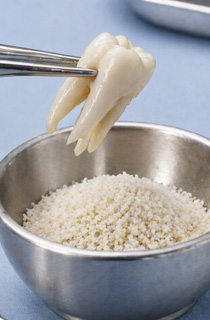
- What does an autogenous bone graft from one’s own teeth mean?
- Is autogenous bone still the gold standard today?
- Watch the process live – video of the entire procedure
- Will the implanted material be absorbed over time?
- Which bone substitute material is the best, and on what basis is the decision made?
- What else is worth knowing: not all teeth are suitable
- How it all works at our clinic – as a dental tourist
Can you use your own teeth for a bone graft?
Yes. In some cases, extracted teeth can be processed into dentin graft material, which is biocompatible and can support bone regeneration.
What does an autogenous bone graft from one’s own teeth mean?
The word autogenous in Greek means “coming from itself”. This describes exactly what it is: the material required for bone replacement is obtained from the patient themselves – not from a donor, not from a laboratory. This can come in two forms. In the first – and increasingly popular – version, the material is obtained from a tooth that is to be removed, typically a wisdom tooth: the extracted tooth is processed into sterile, fine-grained granules using a device called a Tooth Transformer and implanted in the same session. The second version, a piece of bone is taken from a small, less affected area of the jaw – this is used when a larger bone defect needs to be replaced, and the amount obtained from the tooth alone is not sufficient.
In both cases, it is your own tissue. This means that your body does not treat the material as foreign – it recognises it, accepts it and starts working with it. There is no rejection, no allergic reaction, no compatibility issues. The new bone tissue actually grows in, not just fills the space.
How is this different from allogeneic bone grafting?
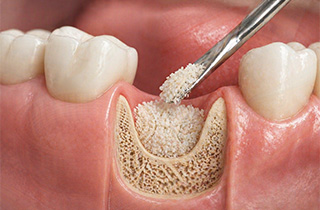 Allogeneic grafts are also made from human bone, but from a donor, a tissue bank, pre-processed and sterilized. This is also a safe and proven solution, but during processing, it loses its living cells and most of its growth factors. It remains a passive framework that sets the direction for the growth of new bone, but does not drive the process itself. For smaller bone replacements, this may be sufficient – but where truly active biological reconstruction is needed, the autogenous solution provides a stronger foundation.
In addition, there is a very practical advantage with a graft obtained from a tooth: if the tooth has to be removed anyway, the extraction and bone replacement can be done in a single session. There is no separate donor area, no second wound in your mouth, and the recovery is also easier. As a dental tourist, this is not an insignificant matter: fewer interventions, fewer return visits, a more transparent schedule. More about dental bone graft materials
Is autogenous bone still the gold standard today?
Yes – and this is not an old dogma, but a recurring confirmation of clinical experience. Autogenous bone graft has been the most recognised solution in bone replacement for decades, because it is biologically the most active: it contains living cells, growth factors and the protein structure that really starts the reconstruction. Neither synthetic nor banked material can bring all this at once. The version obtained from the tooth belongs to this category, with the addition that it is a younger technique – more and more clinical data confirm its effectiveness, but it is not sufficient in every case and not for every defect.
That is why we do not apply it dogmatically: we look at the CBCT scan, assess the size and position of the defect, and decide based on that – graft obtained from the tooth, traditional autologous bone, a combined solution, or another material. What we do not do: we do not choose a cheaper or easier path just because it is more convenient.
Watch the process live – video of the entire procedure
Words can explain a lot, but some things are easier to show. In the video below, you can see step by step how the entire process, from tooth extraction to granulation implantation, takes place. Not abbreviated, not dramatised – as it really happens. If you are seriously considering this solution, it is worth watching before the first consultation.
Will the implanted material be absorbed over time?
Yes – and that’s exactly how it’s designed. Bone grafts don’t stay in their original form forever: the body gradually breaks them down while building real bone tissue in their place. This is an active, living process, not a simple “wearing out” of the material. Dentine-derived grafts are generally more slowly absorbed than other bone grafts, which is good news: there’s more time for new bone to mature before the scaffold disappears. With traditional autologous bone grafts, this rate may be slightly different, but the essence of the process is the same, and in both cases, we calculate this in advance when designing. More about dental bone graft healing process
Which bone substitute material is the best, and on what basis is the decision made?
There is no single “best” material that works for everyone and in every case. The decision always depends on the individual situation: how large the missing bone area is, what is the general health of the patient, and – which is especially important for dental tourists – how many visits can be optimally resolved.
Autogenous bone graft from one’s own teeth is the strongest choice if there is a tooth to be extracted and a need for bone substitute at the same time. In this case, a single session can cover two procedures: extraction and bone grafting at the same time. This is not only more convenient, but as a dental tourist, it clearly involves less travel. If there is no tooth to be extracted, or the defect is larger than the material obtained from the tooth can treat on its own, the surgeon will recommend a different or combined solution – synthetic, bank or xenograft-based material. These are also safe, and their application depends on the clinical picture, not on the price.
What else is worth knowing: not all teeth are suitable
This is rarely mentioned, but it is important. Not all extracted teeth can be processed for dentingraft. If the tooth is severely infected, decayed, or its structure is fragmented, the quality of the material cannot be guaranteed. The best raw material is a tooth that is structurally intact, but needs to be removed for some other reason – for example, due to space constraints, root fracture or prosthetic considerations. This is always clarified during the consultation, and if the tooth is not suitable, the doctor will recommend another solution. There is no point in compromising on the quality of the raw material.
How it all works at our clinic – as a dental tourist
The first visit usually consists of a consultation, the necessary examinations, and if everything is in order, the procedure itself – extraction and bone grafting at the same time. This is followed by a recovery period, usually 3–6 months, which you spend at home. The second visit is about implant placement, the third is about the final tooth replacement. This schedule is predictable, and you will receive it exactly from the beginning – not just approximately, but with specific time frames.
If you would like to know whether an autogenous bone graft from your own teeth is a possibility in your case, the first step is free: send us your dental findings and available X-rays. We will review them, and you will receive feedback before your trip – so you can plan, not just hope. Feel free to contact us if you have any questions: we are committed to ensuring that no question remains unanswered before you get here.
