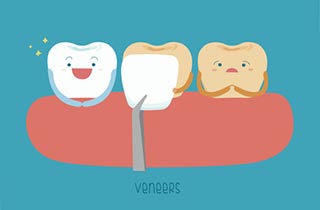
What are veneers on teeth?
Veneers are thin layers bonded to the front surface (lip side) of the teeth for aesthetic purposes. In the past, crowns were often used more frequently for aesthetic corrections, although other options also existed. However, the main disadvantage of that method was that the dentist had to grind down a large portion of the tooth. Today’s veneers represent a much less invasive and more aesthetic solution: the dentist can reshape teeth so that the result looks highly natural and blends harmoniously with the surrounding teeth. The veneers ensure not only bright white teeth, which you have always wanted.
Types of veneers
Veneers can be divided into two groups based on the way they are made. One is a direct veneer that is sculpted on your teeth and the other is the indirect veneer made in a dental laboratory. Let’s see what the main features are.
Direct composite veneers.
Direct or composite veneers are light-cured. The direct veneers are made by the dentist in the dental office within one treatment session. There is no need for a diagnostic cast. It is typically cheaper to make direct veneers, but they are less durable and slightly lower quality.
Indirect, or porcelain veneers.
Indirect, or porcelain veneers, require longer preparation. Before fitting, you need a consultation or other treatments, a diagnostic cast and laboratory work as well. However, thanks to the dental technology used, the construction is much more precise, and the effect is more natural. The Lumineers are transparent coatings made of 0.5 mm-thick porcelain ceramic that do not need to be polished – this is an American brand. Conventional veneers are 1 mm thin, depending on the level of grinding, and typically placed on the front teeth, especially incisors and canines. E-max veneers are usually about 0.3–0.8 mm thin, while crowns can be significantly thicker.
FAQ about veneers
Which materials are the porcelain veneers made of?
made from high-strength ceramic materials such as porcelain or lithium disilicate. Veneers have an excellent transparency and therefore look like natural teeth. In addition, the all-ceramic shells are completely free of metals
Who are Emax veneers and Emax crowns suitable for?
- If you have discoloured teeth
- In case of damaged or broken teeth
- When you want to correct irregularly shaped, distorted teeth
- In case of a gap between the teeth
Advantages of porcelain veneers
- You can achieve a natural effect
- The gums usually tolerate the veneers well
- The porcelain veneers do not discolor
- With porcelain veneers, you can lighten your natural teeth
- The porcelain veneers are nowadays the most suitable solution if you want to change the tooth shape or color – only minimal enamel reduction is usually required
Are 4, 6, 10 Veneers enough?
In many cases, 4 veneers are only sufficient for a limited aesthetic area. Rarely 6, usually 8 Veneers are enough for an average mouth per row of teeth, 10 for a wider mouth.
How many Veneers do you need for a full smile?
Depending on the smile line and tooth position, 8-10 veneers per jaw may be sufficient for a complete smile design.
If the gum line is uneven or receding, gum correction may be necessary before veneers for the best aesthetic outcome. This is how we achieve an aesthetically pleasing result.
Is getting veneers painful?
No, before grinding down, the patient receives a local anesthetic injection
How long do veneers last – are permanent?
The life span of the ceramic shells is 10-15 years, depending on how well ones takes care of them. Since they are made of porcelain, they are extremely durable.
Do porcelain veneers need special care?
They need the same good care as natural teeth, since beneath the shell the teeth can still get caries. Good oral hygiene is especially important: cleaning your teeth twice a day, flossing them and of course a dental check-up twice a year. That is how we avoid development of caries and gingivitis. The latter is particularly important, because gingivitis can cause receding gums over the years, due to which the outer line of the shells may become visible. In such cases, a replacement may become necessary, even if the fixing is still strong and there are no damages or cracks. By cleaning your teeth twice a day thoroughly and using cleansing solutions against dental plaque, you can maintain the shells intact and undamaged for a much longer period.
What can you not do after veneers?
Nail biting and teeth grinding can damage the veneers. Therefore you should get rid of these bad habits and acquire a dental night guard for teeth grinding. This help prevent the harmful consequences of teeth grinding while sleeping.
Can you go back to normal teeth after veneers?
Unfortunately, the answer is no, you cannot fully go back to your original teeth after getting traditional veneers. This is because the procedure usually involves removing a thin layer of enamel from your teeth to make space for the veneers. This enamel doesn’t grow back.
Disadvantage sof porcelain veneers

- The process is final, irreversible
- Veneers are more expensive than composite fillings
- Small defects can sometimes be repaired, but larger breaks usually require replacement.
- The color of the shells does not change along with the color of natural teeth. For example, if you plan to have tooth whitening, you should have it prior to placement of the shells
- In very rare cases, it may happen that the shells become loose or fall off.
- With much teeth grinding or hard biting, the veneers can break or get damaged more easily.
What do veneers look like after 10 years? What will happen?
The Veneers need to be replaced when they wear out, but this is often more than 10 years. With proper dental care, this time can be significantly extended.
- What is the difference between veneers and a dental crown?
Veneers cover only the front surface of the tooth, making them a more conservative option for minor aesthetic corrections. A crown, on the other hand, surrounds the entire tooth and is usually required when the tooth structure is significantly damaged.
- Can veneers be placed on a decayed or filled tooth?
Yes, but only if the tooth is stable and any decay has been properly treated beforehand. In cases of large fillings, the dentist may often recommend a crown, as it can provide a more secure long-term solution.
- Can veneers become stained by coffee or red wine?
Ceramic veneers do not discolour in the same way as natural tooth enamel. However, plaque deposits can develop over time near the bonding margins, which is why regular professional cleaning is important.
- How long does a full veneer smile design take?
In most cases, it can be completed within 5–10 working days, depending on how many teeth are involved and what laboratory technology is required. For international patients, treatment is often organised into two short visits.
- What does “Smile Design” mean in the context of veneers?
Smile Design is a digital planning process in which the dentist can demonstrate the expected shape, length, and shade of the veneers before treatment. This allows patients to preview the likely outcome in advance.
- Can veneers be combined with teeth whitening?
Yes, and it is often recommended. Natural teeth should ideally be whitened first, because the shade of veneers does not change later, making it easier to achieve a uniform colour match.
- When are veneers not recommended?
In cases of severe teeth grinding, untreated bite problems, or active gum disease, the underlying issue should be addressed first. In such situations, veneers alone are not a durable solution.
- What happens if a veneer chips or becomes damaged?
If the damage is minor, it may sometimes be polished or repaired. However, in the case of a larger fracture, the veneer usually needs to be replaced. This is why proper material selection and regular follow-up appointments are essential.
Procedure of porcelain veneers
The placement of a so called shell or several shells generally needs two sessions. A consultation and preparation takes place during the first appointment. In the second session the dentist places the finished work on the tooth – or teeth, since more teeth can be treated at once.
- Diagnosis and preparation of the treatment plan: Here the patient and the treating specialist consult about the teeth that need treatment. They discuss the desired and possible shape, the color of the veneers, and what results can be achieved. The dentist examines the current state of the teeth thoroughly and makes an x-ray.
- What happens to teeth under veneers? Preparation: The dentist, in order to be able to place a porcelain veneer, must grind down up to half a millimeter tooth substance. This width corresponds to the width of the veneers. Before grinding down, the patient receives an anesthetic injection, thus they feels no discomfort. After the dentist has prepared the tooth/teeth, he takes an impression and sends it to the technical laboratory.
- Placement: Before the dentist places the porcelain veneers permanently, he checks the veneers to see whether color and form have become as desired and whether they fit correctly. Immediately before placing, he cleans, polishes and roughens the surface of the tooth. This procedure is necessary for the perfect adhesion of the shell. After fixing and polishing the veneers, the patient can smile with his shiny new teeth.
Read Veneers before and after experiences from our patients and get to know our dental clinics.
Interested? Get yourself a quote for veneers in Hungary or learn about the veneers costs.
For this we kindly ask you to send us the following pictures: with your mouth open a picture of the upper and lower jaw, as well as with your mouth closed a picture of your teeth from the front, left, and right.
[/col]
[/row]